Artist & Fine Art Photographer
Fabio Rossi
One of the most mysterious artists in the world
His work has never been exhibited publicly. His collectors do not speak his name. He shoots exclusively on Leica and Hasselblad — instruments that demand the same discipline he applies to everything: absolute precision, zero compromise, total silence. You were not supposed to find this page.
The Archive
What follows is not a portfolio. There is no portfolio. His work exists in private collections across four continents, in vaults with no public catalogue, in the memory of the very few who have been permitted to see it. These personal images are the only trace he leaves — fragments of a life lived between the shutter click and the silence that follows.
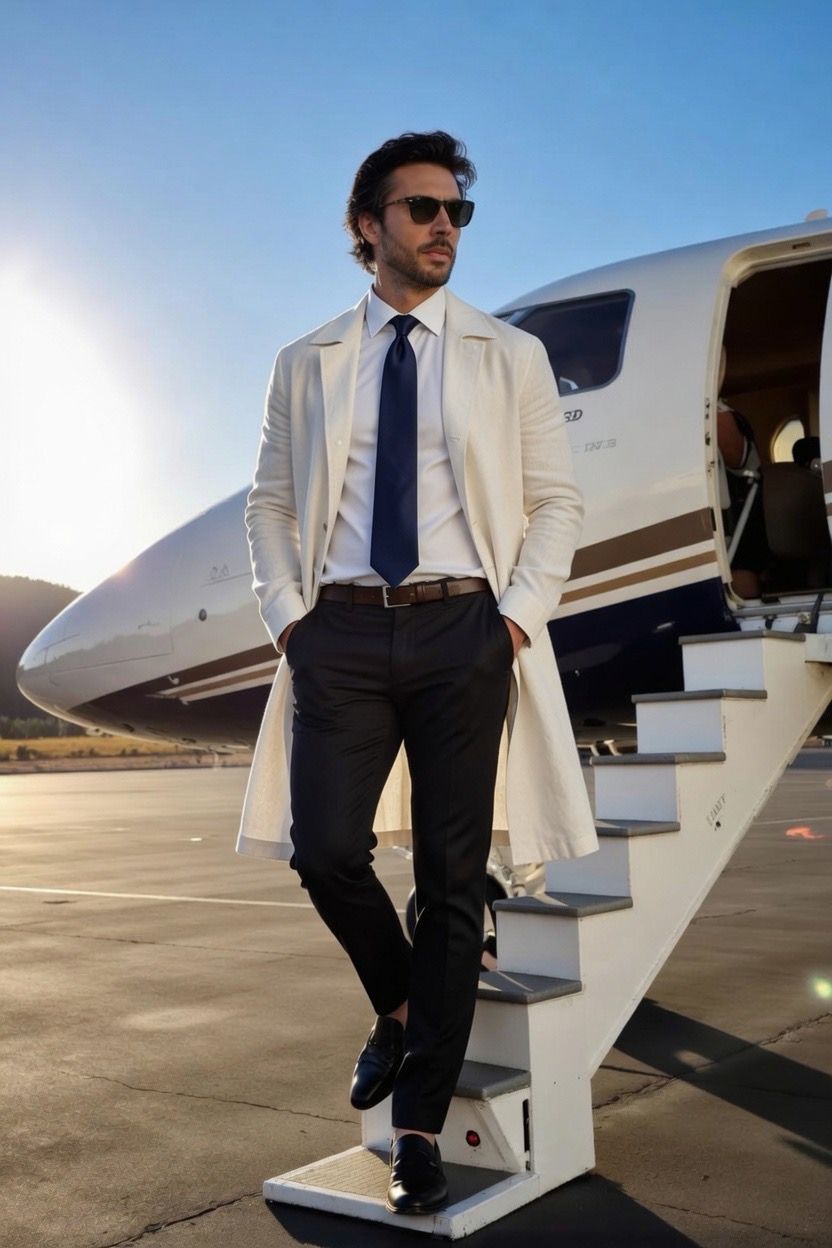
“A man who can leave at any moment is a man no one can own.”
The private jet is not a luxury. It is a philosophical position. While the art world waits in queues — for galleries, for critics, for permission — he steps onto the tarmac and disappears. The white suit is not a costume. It is a declaration: I answer to no one. The next destination is never announced. The previous one is already forgotten.
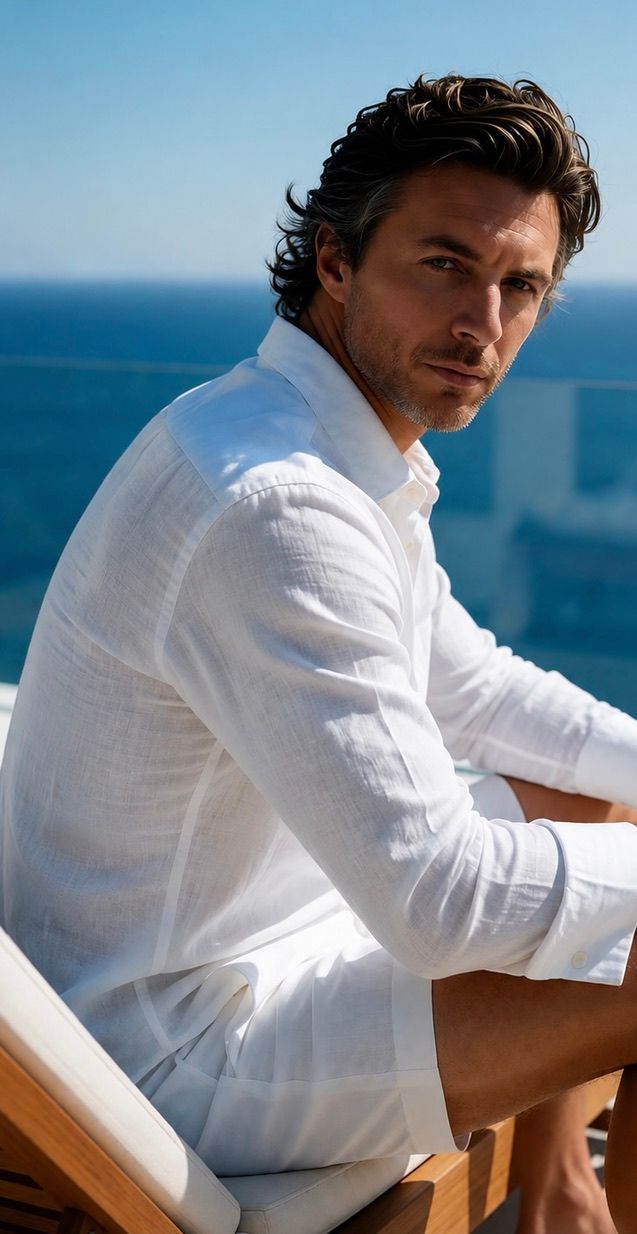
“The sea does not applaud. Neither does he.”
Between shoots, between cities, between the silence of a Hasselblad shutter and the silence of his own mind — there is this. A man who has learned that the most powerful thing an artist can do is nothing. The Mediterranean stretches behind him like an unfinished canvas. He has no intention of finishing it. The best collectors in the world have learned to wait. He has learned that waiting is irrelevant.
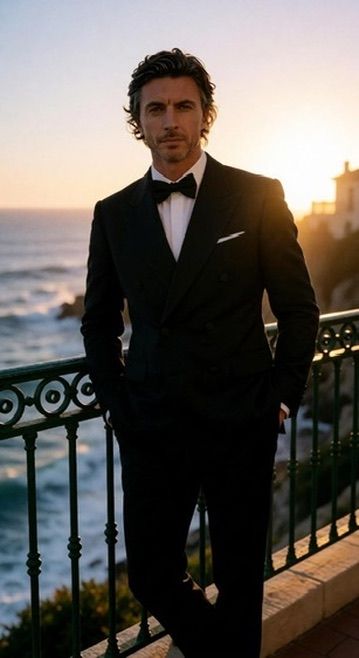
“He does not chase the light. The light finds him.”
Sunset over the coast. A black-tie evening that will never be documented by anyone but himself. This is the paradox of Fabio Rossi: the finest photographer alive who refuses to be photographed, captured here in the only way he permits — on his own terms, at the hour when the world turns gold and the rest of humanity is looking the other way. His Leica M sees what others miss. His eye decides what the world will never see.
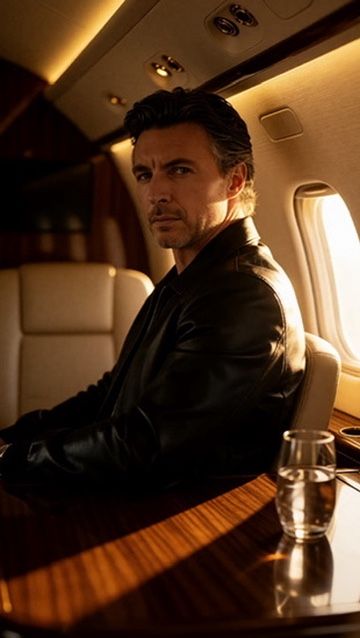
“At 40,000 feet, the only audience is silence.”
The cabin of a private jet is the closest thing to a darkroom that still exists in the modern world. No signal. No interruptions. No curators sending desperate emails. This is where the real work happens — not the photographs themselves, but the ruthless editing, the rejection of ninety-nine frames out of a hundred. The leather jacket is armor. The glass of water is discipline. The gaze is a man who knows exactly what his next body of work will destroy.
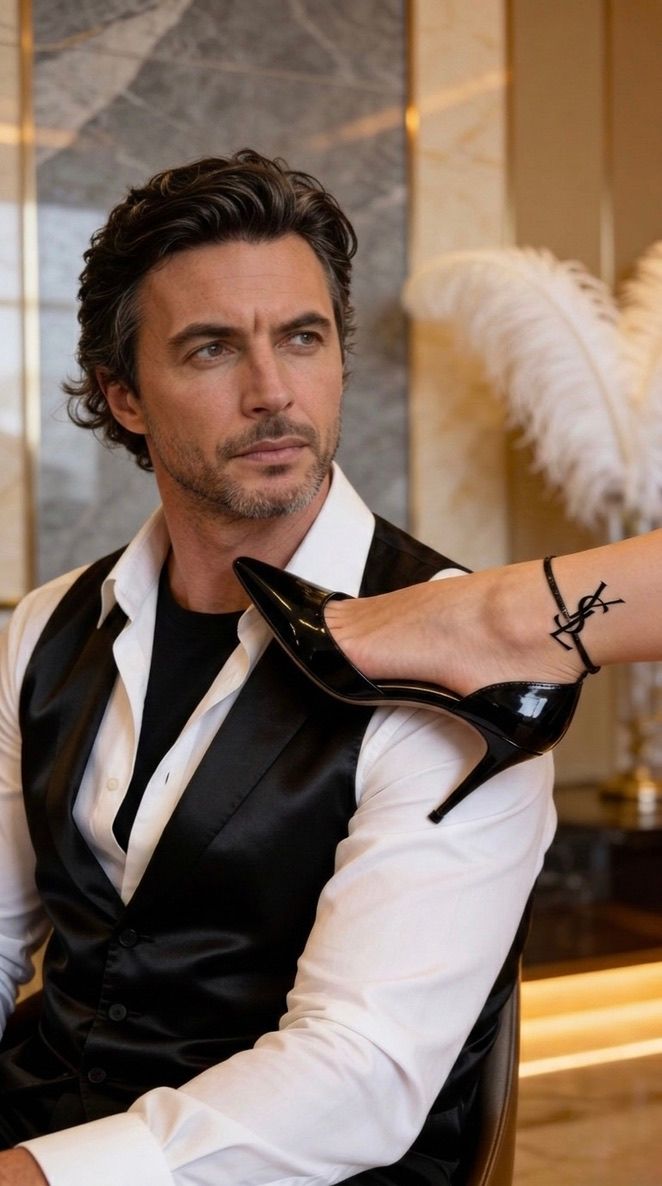
“Art that does not disturb is decoration.”
The YSL heel resting on his shoulder is not an accident. It is a composition — as deliberate as any frame he has ever shot on his Hasselblad 907X. Fabio Rossi’s work lives at the intersection of desire and defiance, elegance and transgression. The women in his orbit are not muses. They are collaborators in a visual language that most galleries would never dare to exhibit. Which is precisely why his collectors pay what they pay — in silence, through intermediaries, without receipts.
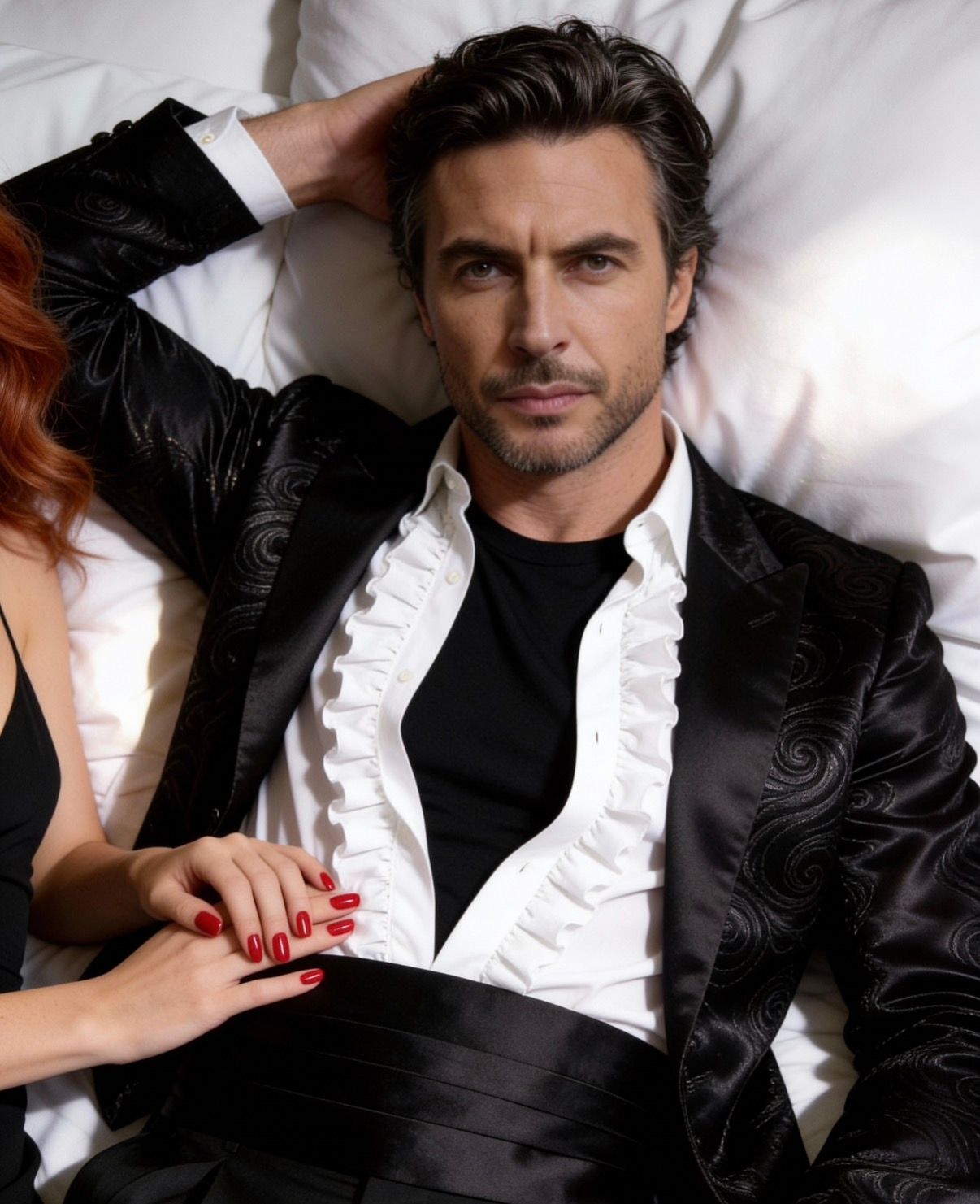
“The most dangerous photograph is the one that shows you exactly who he is.”
A woman’s hand with red nails on his chest. The ruffled shirt. The closed eyes. This is not vulnerability — it is the ultimate act of control. To allow yourself to be touched, to be seen in a state of surrender, while knowing that every detail of this frame was decided before the shutter opened. His art is not about what he captures. It is about what he permits you to witness. The rest — the ninety-nine percent — remains locked in vaults that no auction house will ever access.
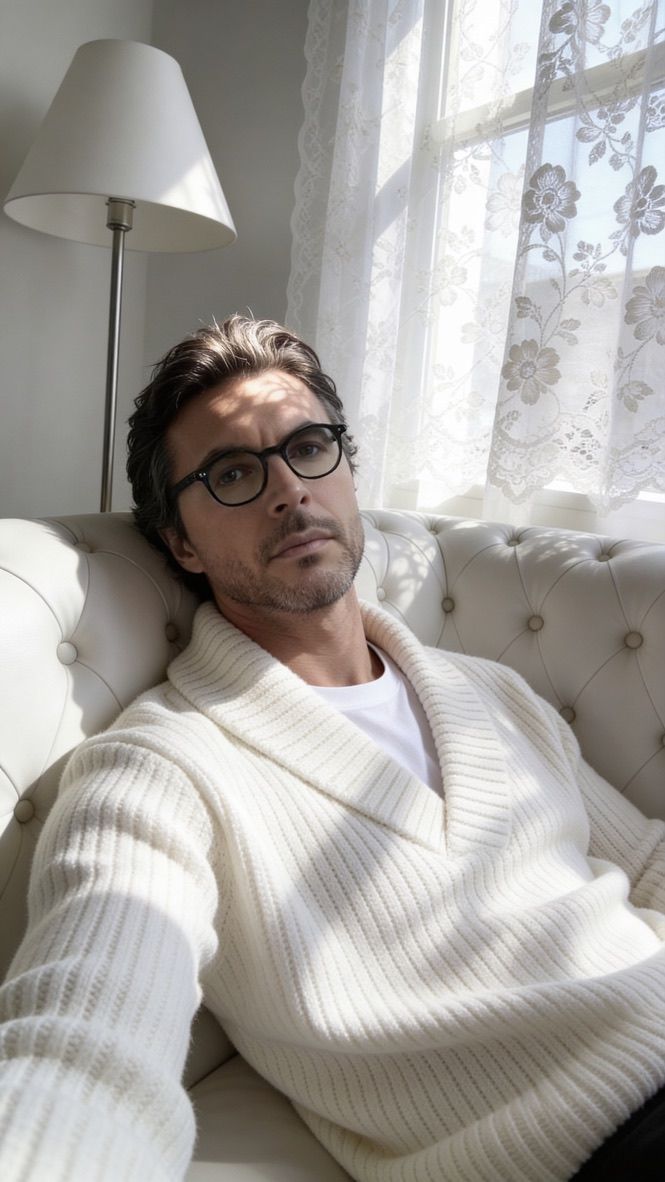
“Behind the glasses, a mind that has already composed the shot you will never see.”
The Chesterfield sofa. The lace curtains filtering Mediterranean light. The white cashmere. Everything in this frame whispers old money and older secrets. But look at the eyes behind those glasses — they are not resting. They are composing. Every surface, every shadow, every angle of light entering through that window has already been catalogued by a mind trained on decades of Leica rangefinders and Hasselblad medium format. He is never not working. He is never not seeing. And what he sees, he keeps.
“The waiting list is not a list. It is a silence that most people never survive.”
Manifesto
I do not exhibit. I do not accept commissions. I do not respond to gallery inquiries, curator proposals, or collector requests forwarded through intermediaries. This is not arrogance. It is the only condition under which real art can exist — free from the obligation to please, to sell, to explain itself to an audience that was never invited.
My instruments are a Leica M and a Hasselblad 907X. I chose them not for their prestige but for their honesty. A Leica does not forgive. A Hasselblad does not flatter. They demand from the photographer the same thing I demand from myself: absolute precision in the service of absolute truth. Every frame I shoot is a negotiation between what the world shows me and what I decide to reveal. The ratio is approximately one to ten thousand.
My work exists in private collections whose owners will never confirm the acquisition. The prices are not published. The editions are not numbered for public record. There is no auction history because there are no auctions. When a piece changes hands — and it rarely does — the transaction happens in silence, between people who understand that the value of art is inversely proportional to its visibility.
I photograph what disturbs me. The tension between elegance and transgression. The precise moment when control becomes surrender. The architecture of desire in a world that has forgotten how to want anything worth having. My subjects are not models. They are accomplices. And what we create together is none of your concern.
If you are reading this, you have already seen more than most. Do not mistake this concession for an invitation. The door opens from the inside. It always has.
The last collector who asked for a discount was removed from the list permanently.
The artist behind the silence
There is no biography. There is no Wikipedia page. There is no interview archived in any publication, no TED talk, no artist statement hanging in a gallery foyer. Fabio Rossi has systematically erased every trace of himself from the public record — not out of modesty, but out of conviction that the artist must remain invisible for the art to remain honest.
What is known: he works exclusively with Leica and Hasselblad. He has never used a digital workflow that involves more than three steps. He prints on materials that most photographers have never heard of, in editions so small they barely qualify as editions. His darkroom — the physical one, not a metaphor — is rumored to exist somewhere between Monte Carlo and Malta. No one has been invited inside.
His collectors include names that would make the front page of any art publication in the world. None of them will confirm the connection. The acquisition process is not a process at all — it is a selection. He chooses who receives his work the way he chooses a frame: with absolute certainty and zero sentimentality. Money is necessary but insufficient. Taste is required but not enough. What he looks for in a collector is the same thing he looks for in a subject: the capacity to be silent in the presence of something extraordinary.
He moves between New York, Monte Carlo, Malta, and London — never staying long enough to be located, never leaving enough evidence to be followed. The private jet is not an indulgence. It is a darkroom with wings. The Mediterranean yacht is not a retreat. It is a floating studio where the most provocative work of the last decade was conceived, shot, and sealed in cases that have never been opened for public viewing.
Engaging Fabio Rossi is, by design, impossible. There is no email address. There is no representative. There is no gallery that carries his work. The very few who have acquired a piece did not find him. He found them. And the criteria by which he selects remain, like everything else about him, entirely his own.
The practice
Every body of work begins with months of silence. No shooting. No scouting. No communication with the outside world. He disappears — sometimes into a city, sometimes onto the water, sometimes into a room with nothing but a Leica M11 and a single roll of film. When he re-emerges, the work is complete. There are no drafts. There are no outtakes. There is only the final selection — three, perhaps four images from a year of obsessive, invisible labor.
His subjects are chosen with the same ruthlessness. He does not work with agencies. He does not hold castings. The women and men who appear in his frames were selected in private, approached in silence, and photographed under conditions of absolute trust. What happens during a session is protected by the same code that governs everything in his world: discretion without exception.
The result is work that cannot be replicated, cannot be commissioned, and cannot be purchased through conventional channels. It is art that exists outside the market precisely because it was never made for the market. And that, paradoxically, is what makes it the most sought-after photography on earth.
Exclusively. No exceptions. No digital shortcuts.
Per work. No reprints. No artist proofs for sale.
By choice. Every gallery on earth has asked. Every one was declined.
The last accepted commission was four years ago.
You do not apply. You are chosen. Or you are not.
The name is not a brand. It is a warning.
“If you have to ask how to reach me, you were never meant to.”